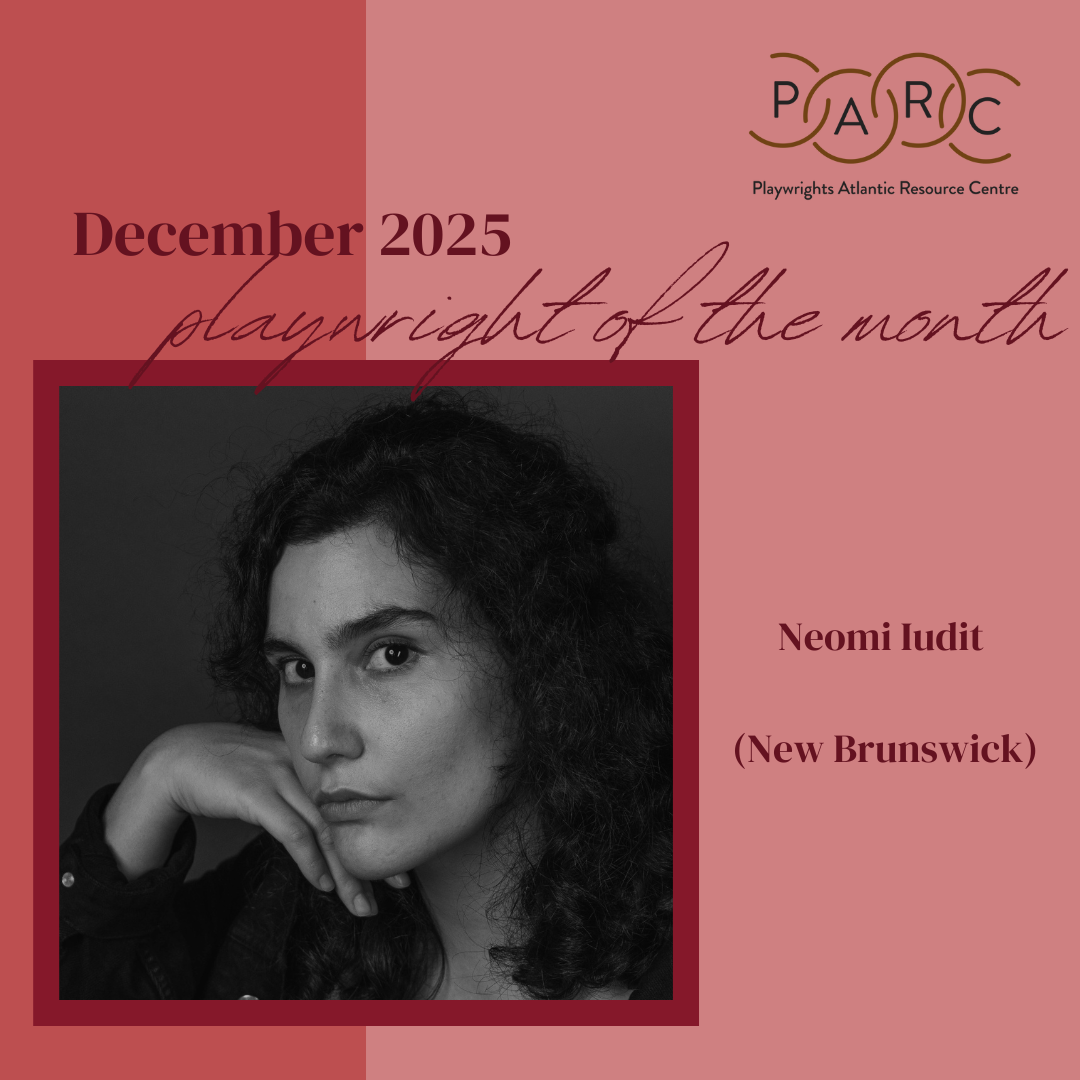
Neomi Iudit is an emerging multidisciplinary artist and administrator working primarily in theatre, creating works that feel intimate and unexpected. Informed by her experience as a racialized immigrant and a Queer and disabled artist of the (ex?) emo, current poet variety, Neomi is working to build a practice that affirms the autonomy of marginalised people in creative spaces. Recently, she shared her poetry at the 2025 Disability Atlantic Arts Symposium’s Cabaret in Halifax, acted in her own site-specific play with Rebel Femme Productions for Flourish Festival, and created a series of monologues and spoken word poems from the perspective of non-human beings as one of the City of Fredericton’s summer Artists in Residence. Currently, Neomi is writing a solo show titled disembarkment, which explores the fractal relationship between the non-normative mind-body, the natural world, and their resistance to the colonial, patriarchal, and capitalist forces that work to degrade them towards uninhabitability. She is part of the 2025-2026 cohorts for PACT’s Rising Tides program, and the Black Theatre Workshop’s Artist Mentorship Program, and has been a member of PARC since 2023.
We asked some questions so our members could get to know Neomi a bit better.
What are some Plays that have stayed with you or influenced your work?
There’s lots that have stayed with me, I’ll keep it to recent ones. Braiding Peonies by Sobia Shaheen Shaikh just went up at TODOS Productions and while I didn’t get to see it, I got to sit in on a reading of an earlier draft at PARC’s 2024 retreat and it was stunning even then. I just read There is Violence and There is Righteous Violence and There is Death or, The Born-Again Crow by Caleigh Crow, and English by Sanaz Toossi and both hit very close to home in different ways. I saw a play called Sorry For Your Loss by Cian Parker at Prismatic Festival in the fall. That one really stays with me for how intimate and vulnerable it was, just a simple story told with so much skill and love. There was also an artistic integration of ASL interpretation by Gaitrie Persaud-Killings which is something I’ve never seen done before but want to see all the time now. It made me rethink my own projects and conceptions of accessibility in a way I really value. Over the summer, I got to see a performance of Crane Girl by Alexa Higgins at NotaBle Acts Theatre Festival (Falling Iguana Theatre Company) which I think about all the time. Every part of it was so meticulous, but it also created a story through physical theatre that, I think, just couldn’t be as impactful told through any other form.
What are some questions you’re exploring or investigating in your work right now?
I’m always coming back to the interplays of autonomy and interdependence. I think especially as someone whose physical ability has changed a lot over the past few years and whose understanding of my worth has been so connected to my ability to get by and take care of my own needs, and those of the people around me for that matter, that’s been an interesting thing to explore in my writing and something that a lot of people can connect to. Like what is the price we pay for resilience? How do we ask for and accept help, and build relationships based on reciprocity when all that has been modelled for us is extraction?
The thing I’m currently working on is a solo show that explores the relationship between neurodivergence and disability, and the natural world. I’m interested in exploring how the body and mind’s experiences of oppression and trauma are contained within the earth’s and that of our non-human kin, and vice-versa. How is gravity, air pressure, and temperature felt in the non-normative mind-body? How are those effects mitigated or exacerbated by access or lack thereof to housing, medical and community care, climate change, borders, pollution, and the effects of intergenerational and everyday trauma? What happens if the mind-body-Earth is too degraded to be habitable, and how can we find the desire to live fully and resist helplessness amidst it all?
Do you have any rituals or routines that fuel your creative process?
This definitely isn’t for everyone, and also something to obviously do with a lot of moderation. Sometimes I find writing very late at night or early early morning to be very helpful, especially if I’m at the point of a project where I’ve been working on it for so long that I feel crazy for ever starting it in the first place. If I’m the only one up and the streets out the window are empty it’s like I’m in my own world and it’s just me and the story. It just allows me to make choices without having to find justification for them right away, it’s a choice that comes from pure intuition and connections my subconscious made that my awake brain hasn’t caught up with yet. And when I’ve had some sleep and look back on them a lot of times they’re my favorite ones and ones that break something open in the piece and get at the heart of it. Sleep deprivation is good sometimes, is my take.
Tell us a bit about the role that PARC has played in your development as a writer and an artist.
PARC has been really helpful to my development even just through these bulletins. I’ve found tons of opportunities through them both directly and indirectly. I was also lucky enough to participate in the PARC Retreat in 2024, where I met artists I continue to learn from and be inspired by, and got to develop my play in a very supportive and artist-focused environment. I’m lucky to be in community with several excellent artists who I can collaborate with and get feedback from, but being a part of PARC helps me feel connected to the wider community and understand my work within a wider context.
Contact Neomi: