
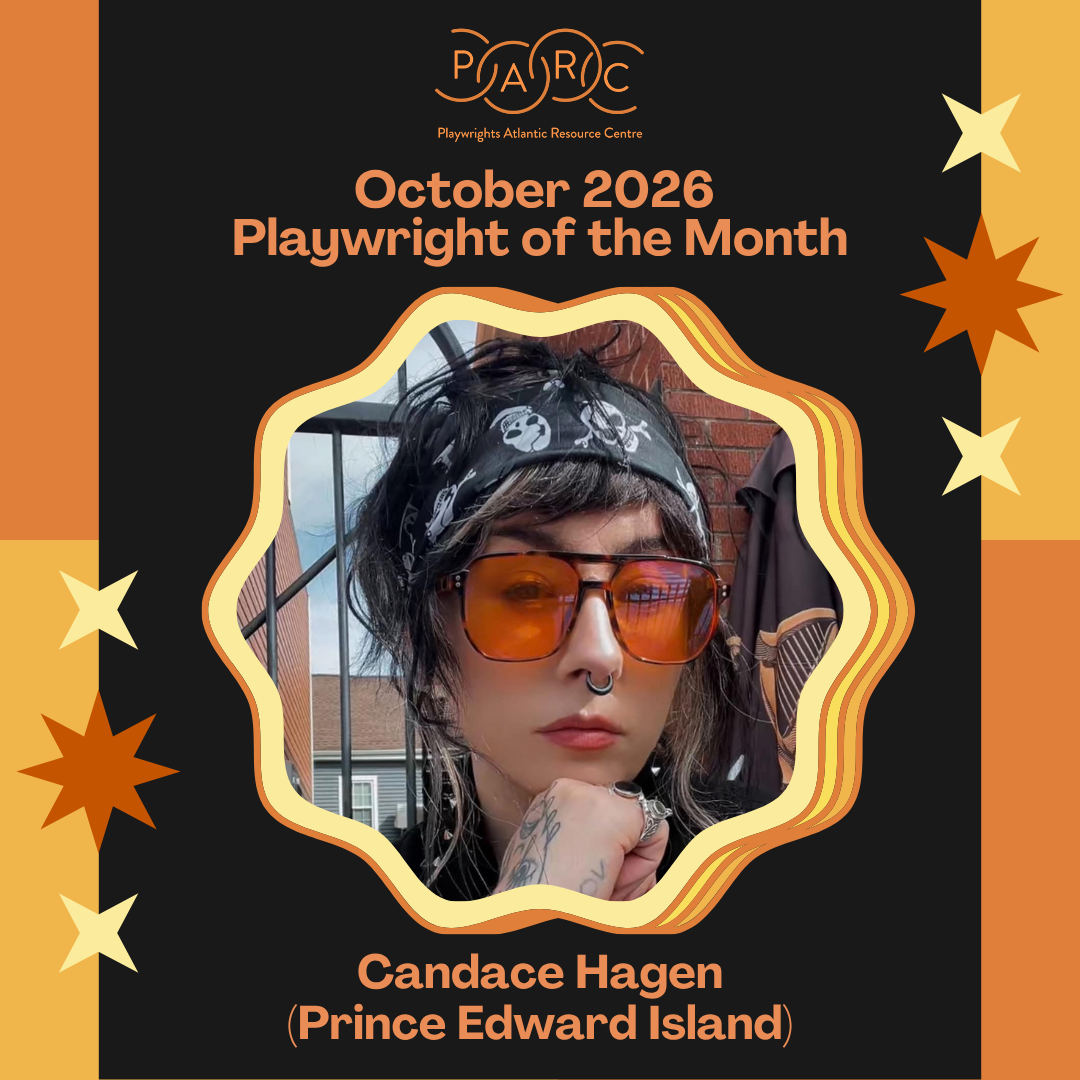
The Playwright of the Month for October 2026 is Candace Hagen (PEI)!
Candace Hagen is a reluctant playwright and director in continuous development, writing & creating on the salty shores of Epekwitk. She considers most of her work a dark observation of human connection. A frequent beneficiary of the Island Fringe Festival lottery, she keeps showing up with new scripts, turning interpersonal chaos into other people’s evening plans.
Her works include Realizations (2018; remounted 2019), an Island Fringe Patron’s Pick; Blackberries (2020, co-writer); Salty (2021); How It Happened (2024, co-written with Benton Hartley); and BUTTER (2025, co-written with Brynn Cutcliffe and Jay Whitehead).
She wrote, directed, & produced Provocation (2023), about the founding of the PEI Rape & Sexual Assault Centre, and wrote and produced Captain Courage & the 7Cs of Resiliency, which toured Island schools in 2024 and again in 2025. Her play, Afterbirth (2025), received The Island Fringe Festival Staff Pick award.
Her latest work, When There’s Nothing Left to Say, comes to The Island Fringe Festival October 8-11, 2026, through Leather & Loathing Productions, founded in co-conspiracy with Rosie Shaw. It began as a scene with only one sentence — five words that captured an exhaustion you can’t fully name within a relationship. Six more vignettes explore how that exhaustion becomes a conscious disclosure.
We asked some questions so our members could get to know Candace a bit better.
What are some Plays that have stayed with you or influenced your work?
Saying Equus feels like an unhinged answer. To be honest, I didn’t grow up with scripts or theatre in my bones; Richard Lemm forced it on me during my undergrad creative writing classes. After taking every course offered at every level, I had become a virtuoso of dialogue avoidance. I went to extraordinary lengths to ensure no one in my writing spoke directly to anybody else.
I think it was a thimble having an internal crisis over deforestation — in an exercise meant to explore dialogue — that prompted his next assignment: five pages, two people talking to each other. Only dialogue. Nothing else.
I wrote it sweating and half drunk in a coffee shop that has since been gentrified. Those intensive forty-five minutes became the foundation for Salty. One scene was eventually staged; the rest remains neglected in multiple drafts in my Google Docs. But I was hooked. I threw my poetry manuscripts in the trash and started writing plays.
All of that to say, I could research and Google the names of scripts I’ve read or plays I’ve watched — but that isn’t what stays with me; it’s the moments of writing and witnessing in collaboration with others that influence my work. Local theatre inspires me — watching radical creatives like Brynn Cutcliffe, Jay Whitehead, Rebecca Parent, Rosie Shaw, John MacCormac, Graham Putnam, and Benton Hartley… I could go on.
What stays with me is the bravery of those who put their work on a stage, any stage, and the privilege of watching artists thrive and grow together. It’s the people, the symbiosis, the osmosis of collaboration. For someone who had to be forced into writing a script, I am an accumulation of every creative I’ve worked with who had the gorgeous audacity to take up space.
What are some questions you’re exploring or investigating in your work right now?
Take my hand (or don’t, in fact — I’d rather you didn’t; just walk beside me at a respectable distance) as we go through my current processing-as-a-writer labyrinth.
How do I write the ordinary until it becomes unbearable? How do I build anxiety and fear into a conversation where, ostensibly, nothing is happening? When does a familiar gesture become unsettling, and how much needs to change on the page for us to feel it? How does pedestrian intent become villainous? At what point does a character’s understanding of themselves stop them from accommodating what I’ve written them doing?
How much do I trust the audience, the witnesses, to find what I’ve left between the lines? Where am I giving them room to discover something, and where am I over-explaining because I’m afraid of being misunderstood? And is that fear based in the self, or the character? And when does that stop being something I have a right to know? Can I leave silence unresolved without writing around it to make sure everyone gets the point? And what “points” genuinely matter, and to whom, and why? And what role do I truly play in any of that? How do I write the fragility of being human without explaining it away? What basic emotions connect us, and how does writing further into the particulars of one life make it recognizable to someone who has lived an entirely different one?
And how much of ourselves and of others do we weave into these characters? What does consent look like in playwriting? Do we truly own everything that has ever happened to us? What responsibility do we have to those we pull scraps and threads off of to weave into our own work? Do we ever get back what we’ve left behind? I’m curious about what becomes possible when I allow myself to loosen my grip on what I thought the play was, let ego death happen in a blaze of glory, and let collaboration send me back into the writing for a developmental rebirth.
Do you have any rituals or routines that fuel your creative process?
My ritual is executive dysfunction and task paralysis. My fuel is crushing anxiety, internal dread, whiskey shots, the crushing fear of mediocrity, and the deep desire to create work that fosters connection in a timeline where we are so far from ourselves, and one another.
Tell us a bit about the role that PARC has played in your development as a writer and an artist.
In February 2026, Santiago reached out about developmental support for Afterbirth, after I’d submitted it for PARC’s annual Playwrights’ Retreat. My initial thought was: development for what — it’s done. (Yes, the irony of submitting a play to a retreat while believing it was “complete” doesn’t escape me.)
In March, they reached out again with an offer of workshopping, dramaturgical support, and a staged reading at April’s Island Playwrights’ Cabaret. It seemed like a nothing-to-lose-something-to-gain scenario, so I responded with enthusiasm, and we went for it.
Working on the script with Santiago was illuminating. No, in truth & perhaps also in cliché, it was a revelation. Afterbirth was far from complete. More characters waited to be discovered, and Theadora Finch had so much more to reveal than I’d realized. Staging the play wasn’t the final word; it was part of its ongoing development. I had to wage a battle with my own naïveté and “one and done” mentality.
PARC’s support has pushed me deeper as a writer — to ask more questions, to pull up a chair and interrogate the characters in my plays in ways I hadn’t before. It’s been a fucking eye-opening journey, and I’m grateful for it.